Multi-brain LLM routing
Sending everything through Sonnet costs more than it needs to. Sending everything through Haiku breaks the moment it gets to be more than a greeting. Somewhere in between you want a router that picks the right model per request. My preference: cheap heuristics first, an LLM classifier as fallback, not as the default.
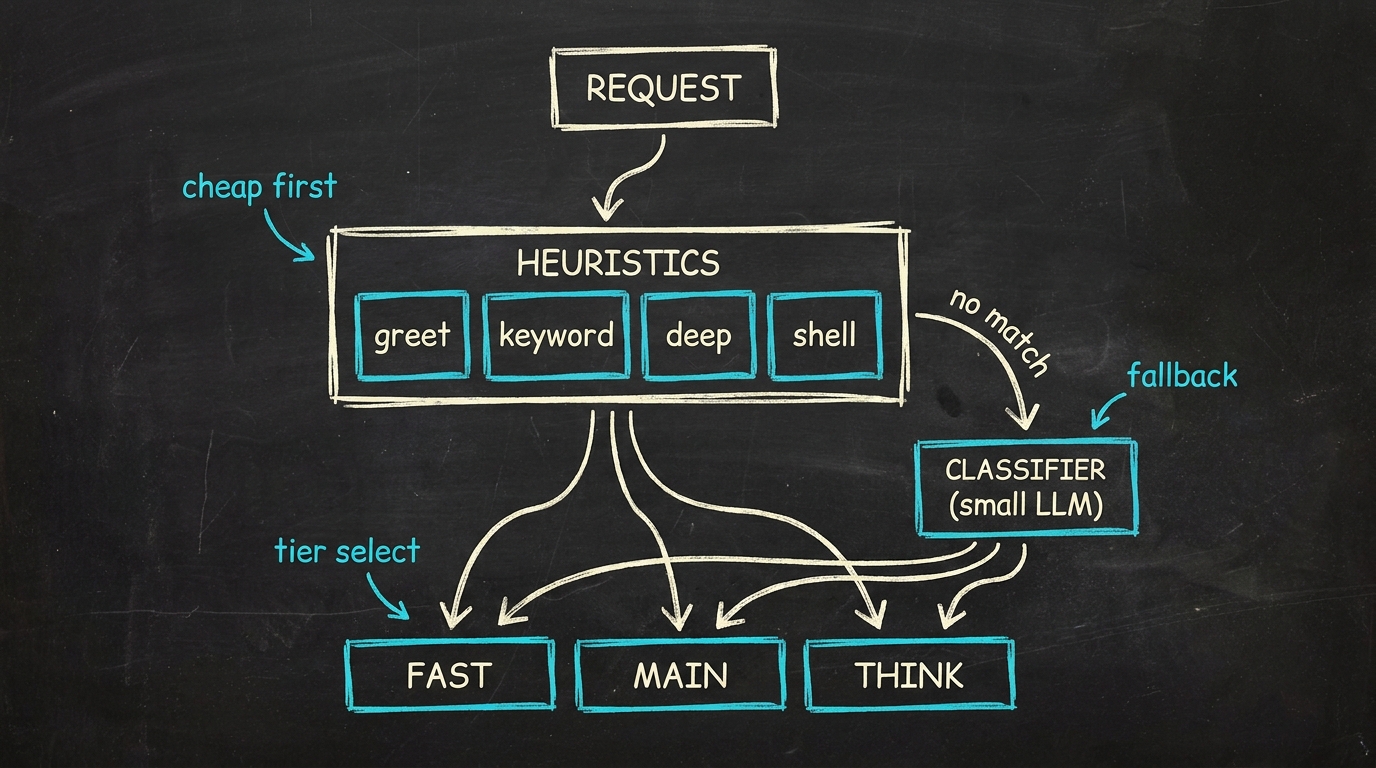
Whiteboard sketch · the routing flow
The shape
async def decide(text: str, *, force: Brain | None = None) -> RouterDecision:
    if force is not None:
        return RouterDecision(force, "manual", "user-override")

    # Layer 1: cheap regex heuristics (microseconds, free)
    h = _heuristic(text)
    if h is not None:
        return h

    # Layer 2: LLM classifier (Haiku, ~30 input tokens, sub-second)
    return await _llm_classify(text)
Layer 1 catches the bulk for free. "Hi" goes to the fast tier. Anything
that hits a keyword for tool use, deep reasoning, or a specific domain goes
straight to the right tier. Layer 2 only fires when the heuristics
genuinely have no idea.
The win isn't in a clever heuristic. It's in the layered structure: cheap
first, expensive only when it has to be, both visible through the same
RouterDecision object so afterwards you can see exactly what was chosen
and why.
What heuristics catch
Four categories usually handle 70-80% of the decisions:
-
Short greetings and time questions: inputs under 20 characters that match a small regex set. Routed to the cheapest, fastest tier. Someone who says "hi" doesn't need Sonnet.
-
Domain keywords: terms that point to a specific product or context. Routed to the tier that loads the right system-prompt context. Essential in a multi-product orchestrator; otherwise the agent ends up reasoning from the wrong context.
-
Deep-reasoning keywords: "design", "architect", "refactor", "review", "in-depth". Bumped up to Opus / Sonnet 4.6 / whatever your top tier is. Cheap to detect, expensive to miss.
-
Tool-use signals: file paths, shell verbs ("scan", "check", "read"), code-fence markers. Routed to the tier where shell tools are available.
That last one is a silent killer. Without that check, a small model writes the shell command out as Markdown instead of calling the tool. The fix lives at the routing layer, not in the prompt.
What the classifier covers
When the heuristics return None you hit a small LLM (Haiku class) with a
fixed instruction:
You are a routing classifier. Given a user message, output exactly ONE word:
- 'fast' for trivial greetings, time questions, simple confirmations
- 'main' for normal conversation, document Q&A, summaries, smart-home
- 'deep' for multi-step reasoning, code review, complex analysis
Output ONLY the single word, nothing else.
Cost per classification: a few tenths of a cent. Latency: sub-second. Robustness: high. Haiku is consistent enough on a three-way choice like this that you don't need a bigger model.
One small but real win: tell the classifier to lean toward main when in
doubt rather than fast. A trivial request via main costs little extra.
A tool-requesting request that accidentally goes to fast (and then never
calls the tool) costs a lot more.
When you don't need a router
If every request that comes in has roughly the same shape (a chatbot that does one thing, say), this is overkill. The router pays for itself the moment:
- Your requests span a range from trivial to deep
- You have multiple tiers available
- Cost is a real factor (solo-founder budget, freemium, high volume)
- Tools are in play (where misrouting causes real failures, not just costly inefficiency)
Two of those four hold? Then the router pays for itself within a week.
Observability matters more than the router
Return a structured RouterDecision object with the chosen tier, which
layer decided (heuristic / haiku / fallback), the reason, and the elapsed
time. That makes the whole thing inspectable. After 200 requests you scroll
through the log and see exactly where the heuristics are off, where the
classifier hesitates, and where you're paying for main when fast would
have done.
Without that log the router becomes a black box that you eventually throw out because "it's down to the router." With that log the router is a knob you tweak.